Uzbekistan and Jordan to cut tariffs on 300 types of goods
−
690 3 minutes
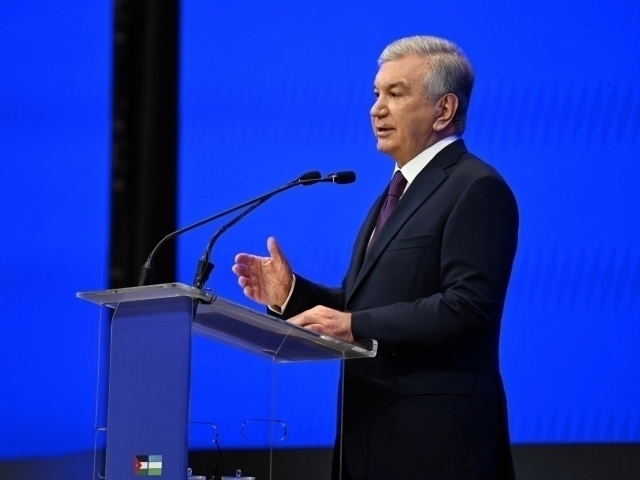
Customs duties on 300 types of goods will be reduced between Uzbekistan and Jordan. This was announced today, November 24, at the opening ceremony of the Uzbekistan – Jordan Business Forum, attended by President of the Republic of Uzbekistan Shavkat Mirziyoyev.
The event brought together government officials, heads of leading companies, and business community representatives from both countries.
King Abdullah II ibn Al-Hussein of Jordan and Chairman of the Jordan Chamber of Industry Fathi Al-Jaghbir also addressed the forum.
In his speech, the Uzbek President emphasized that the Jordanian King’s historic visit to Samarkand last year opened a new chapter in bilateral relations.
Thanks to active high-level dialogue, economic cooperation has been steadily expanding. Over the past five years, bilateral trade volume has grown nearly ninefold, surging by 80 percent in 2025 alone. More than 20 enterprises with Jordanian capital are currently operating in Uzbekistan.
Direct flights have been launched between Tashkent and Amman, and a mutual visa-free regime has been introduced. The inaugural meetings of the Intergovernmental Commission and the Business Council were also successfully held.
It was noted with satisfaction that a Preferential Trade Agreement was signed during the state visit, providing for the application of reduced customs duty rates on 300 categories of goods.
The President expressed confidence that this agreement will lay a solid foundation for significantly boosting mutual deliveries and increasing bilateral trade turnover to $500 million.
Welcoming the substantial contracts and agreements signed during the business forum, the Uzbek leader outlined five priority areas for expanding economic partnership:
First — the textile industry. Proposals were put forward to establish joint production in the Aqaba Special Economic Zone using Uzbek raw materials and semi-finished products, with the aim of jointly exporting finished goods to third-country markets.
Second — the mining industry. Jordanian investors were invited to collaborate at the "Metals of the Future" technoparks being established in Tashkent and Samarkand to implement joint projects in critical minerals.
Third — the pharmaceutical industry. The importance of jointly localizing the production of new types of pharmaceuticals and launching advanced technology transfers was highlighted, with necessary conditions and incentives to be created for Jordanian partners at the Tashkent Pharma Park cluster.
Fourth — the chemical industry. Prospects for producing competitive mineral fertilizers by combining both countries' capacities were outlined, alongside welcoming agreements reached on manufacturing feed additives, household chemicals, and crop protection products.
Fifth — agriculture. It was emphasized that establishing joint agro-industrial clusters and developing seed production, horticulture, and livestock farming could make a significant contribution to ensuring food security in both nations.
The head of state also noted vast opportunities for expanding tourism cooperation, stressing that the mutual visa-free regime and direct air links create favorable conditions for increasing tourist flows.
The President invited Jordanian friends to visit the ancient cities of Samarkand, Bukhara, and Khiva—great historical and spiritual centers of the Islamic world.
During business-to-business meetings at the forum, participants also discussed prospects for joint projects in the leather industry, telemedicine, food production, construction materials, electrical engineering, and logistics.
Jordanian entrepreneurs were briefed on Uzbekistan's favorable investment climate, the operations of free economic zones, and opportunities for industrial cooperation.
It was announced that the next Uzbekistan – Jordan Business Forum will be held in Tashkent in March next year. The head of state called on Jordanian partners to actively participate with new proposals and initiatives, and urged Uzbek entrepreneurs to make full use of opportunities in the Jordanian market.
The implementation of the reached agreements and joint projects will be regularly monitored within the framework of the Intergovernmental Commission.

Live
All