An architect born in Jerusalem, or who is Netanyahu really?
Review
−
06 June 10730 10 minutes
Some see him as a savior who turned Israel into a modern and powerful state, while others view him as one of the most dangerous politicians to have plunged the Middle East into bloodshed. But one fact cannot be denied: for nearly a quarter of a century, war and peace, alliances and conflicts in this region have revolved around the decisions of one man. That man is Benjamin Netanyahu. So who is the leader who has shaken global politics? How did he rise from an ordinary soldier to become the longest-serving leader in his country’s history, and where have the wars he started brought the world today? In the coming minutes, we take a closer look at the mysterious personality of Israeli leader Netanyahu, his political maneuvers and the new world order being shaped because of him.
Benjamin Netanyahu was born on October 21, 1949, in Tel Aviv and grew up in Jerusalem. Among his relatives and the public, he is known by the nickname “Bibi.” His personal life has been as eventful as his political career. Netanyahu has been married three times. His first marriage was to Miriam Weizmann in 1972, and they remained together until 1978. Netanyahu has a daughter named Noa from this marriage. In 1981, he married Fleur Cates, but that relationship also did not last long and ended in divorce in 1988. The politician’s most stable and long-lasting marriage began in 1991, when he married Sara Ben-Artzi. Today, Sara Netanyahu is not only the country’s first lady, but also a woman with a distinct place in Israeli history. Sara and Benjamin Netanyahu have two sons.
His father, prominent historian Benzion Netanyahu, played a major role in shaping Netanyahu’s Western worldview. Due to his father’s academic career, the family moved to the United States for a period of time. The future politician spent his teenage years near Philadelphia and graduated from high school there.
Life in the United States gave Netanyahu the opportunity to study at some of the world’s most prestigious universities. He earned a bachelor’s degree in architecture and a master’s degree in business administration from the Massachusetts Institute of Technology. His interest in academia later led him to Harvard University, where he studied political science.
However, Netanyahu’s life was not spent only among books. In 1967, Benjamin returned to his homeland and was drafted into the Israel Defense Forces. He served in the country’s elite special forces unit, Sayeret Matkal, and rose to the rank of captain. In 1972, he directly participated in a highly dangerous operation to rescue passengers from a hijacked plane and was wounded in combat.
Political career
Benjamin Netanyahu is considered one of the most influential and controversial politicians in modern Israeli history. He came to power three times and served as prime minister for more than 18 years. In 1996, Netanyahu won Israel’s first direct prime ministerial election. He narrowly defeated former Prime Minister Shimon Peres. During this period, he took a firm position on the issue of a Palestinian state, continued expanding Jewish settlements and strengthened Israel’s security policy.
In addition, operations in southern Lebanon continued, and the Israeli army maintained its security zone in Lebanon. Three years later, in the 1999 election, Netanyahu lost to Ehud Barak and left office. However, this did not end his political career. From 2003 to 2005, he served as finance minister. During this period, he carried out many measures that benefited the country. In particular, he cut public spending, expanded privatization programs and implemented market economy reforms. Many economists note that the policies of this period played an important role in Israel’s later economic growth.
In 2009, Netanyahu returned to power. From that year onward, he increasingly presented Iran as the main threat. In almost all of his international speeches, Netanyahu described Iran’s nuclear program as the greatest danger to Israel. He urged the United States to adopt a tougher policy toward Iran. At the same time, wars with Hamas intensified. During his leadership, several major military operations took place in Gaza. These included Operation Pillar of Defense in 2012, Operation Protective Edge in 2014 and Operation Guardian of the Walls in 2021. Israel has consistently maintained that all these operations were launched in response to Hamas rocket attacks. The war that began in the Gaza Strip in October 2023 was also justified on this basis.
Rapprochement with Arab states
In 2020, Israel established friendly and strong relations with Arab states, including the United Arab Emirates, Bahrain, Morocco and Sudan. This process went down in history as the Abraham Accords. The name “Abraham” carries symbolic meaning. In Islam, Christianity and Judaism, Abraham is revered as a common prophet and great patriarch. Through this name, the authors of the document sought to express the shared roots of Arab and Jewish peoples and their aspiration for peace. The agreement became one of the major geopolitical events that helped thaw years of political hostility in the Middle East. U.S. President Donald Trump played an important role in the signing of the document. The official signing ceremony took place at the White House in Washington on September 15, 2020.
It is worth noting an interesting fact. Before the Abraham Accords, only Egypt in 1979 and Jordan in 1994 had signed official peace treaties with Israel among Arab countries. After a 26-year pause, the UAE, Bahrain and Morocco became the next Arab states to take this step. The main political and economic reasons for the agreement were presented as the strengthening of Iran’s position in the region and Israel’s temporary agreement to suspend plans to formally annex Palestinian lands in the West Bank.
As a result of the Abraham Accords, dozens of flights began operating daily between Tel Aviv and Dubai. Hundreds of thousands of Israeli tourists traveled to the Emirates. Israel opened embassies in Abu Dhabi and Manama, while the UAE and Bahrain opened embassies in Tel Aviv. Trade turnover between Israel and the UAE alone reached billions of dollars within a short period. Agreements on free trade zones were also signed.
Netanyahu’s departure from power
In 2019, Israel’s attorney general announced charges of fraud, bribery and breach of trust against Netanyahu, making him the first sitting prime minister in the country’s history to formally stand trial. He was accused of receiving illegal gifts, secretly colluding with media outlets and committing bribery-related offenses. Court proceedings in these cases are still ongoing. Netanyahu has completely denied all charges, describing them as a “witch hunt” organized by his political opponents.
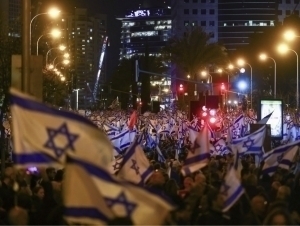
Against the background of these disputes, various parties formed a coalition against Netanyahu in 2021. As a result, he left the premiership and became opposition leader. Not long afterward, in December 2022, Netanyahu again became prime minister. This time, he formed one of the most right-wing governments in Israeli history. He then moved to reduce the powers of the Supreme Court and expand the powers of parliament. This sparked some of the largest protests in Israel’s history. On October 7, 2023, Hamas launched a large-scale attack on Israeli territory. Netanyahu responded by declaring war. Thousands of rockets were fired, and hundreds of people were killed and taken hostage. This became one of the defining events of his political career.
Relations with U.S. presidents
During the presidency of George W. Bush, the 43rd president of the United States, U.S.-Israel cooperation strengthened. At that time, the fight against terrorism brought the two countries even closer. The September 11 attacks in 2001 also contributed to a sharper attitude toward Muslim countries in the United States.
Under Barack Obama, the 44th president of the United States, relations between Washington and Israel became tense. In 2015, Iran, the United States and other major powers signed a nuclear agreement known as the Joint Comprehensive Plan of Action. According to the Obama administration, the agreement would limit Iran’s ability to develop nuclear weapons, strengthen international monitoring and reduce the risk of war in the Middle East.
Netanyahu strongly opposed the agreement and considered it a threat to Israel’s security. For this reason, some Israeli politicians criticized Obama for being “too soft” on Iran. However, Obama did not support Iran as a U.S. ally. On the contrary, he tried to limit Iran’s nuclear program. At the same time, Obama attempted to revive peace talks with the Palestinians. This position repeatedly caused disagreements with Netanyahu’s government. That same year, Netanyahu openly criticized Obama’s Iran policy in the U.S. Congress.
Netanyahu had friendly, even very close, relations with Donald Trump, the 45th and 47th president of the United States. During Trump’s presidency, the United States recognized Jerusalem as Israel’s capital, moved the U.S. embassy to Jerusalem and helped broker the Abraham Accords. This, in turn, was regarded as one of Netanyahu’s diplomatic achievements both domestically and internationally. Joe Biden, the country’s 46th president, had also known Netanyahu for several decades.
Conflict with Palestine and Iran
The war and bloodshed that began in the Gaza Strip on October 7, 2023, shocked the entire world. During the war, tens of thousands of Palestinians were killed in Gaza, large parts of the territory were destroyed and millions of people were forced to flee. Children and civilians have suffered from hunger and harsh wartime conditions. Israel has also repeatedly blocked the entry of humanitarian aid into Palestine. In 2024, the International Criminal Court issued arrest warrants for Netanyahu and former Defense Minister Yoav Gallant over alleged war crimes and crimes against humanity.
Netanyahu’s government is facing accusations of war crimes, crimes against humanity and genocide, although Israel rejects these accusations and the cases continue in international courts. In early 2026, Netanyahu’s government announced that it had launched a large-scale war with Iran. The Israeli government explained the move as necessary to eliminate Iran’s nuclear and military capabilities.
Initially, Trump and Netanyahu claimed that Iran would be occupied within 10 days, but Iran did not prove to be as weak as they had expected. Iran launched intense attacks against the opposing side. The U.S.-Iran-Israel war, which began on the night of March 1 this year, is still continuing.
How is Netanyahu assessed?
There is no unanimous view of Netanyahu among historians and political scientists. Some consider him one of Israel’s most influential leaders after David Ben-Gurion. Others describe him as one of the most divisive politicians in the country’s history.
Nevertheless, most experts agree on one point: Benjamin Netanyahu is one of the political figures who has most shaped Middle Eastern politics in the 21st century. His decisions have had a major impact not only on Israel and Palestine, but also on the entire region and U.S.-Middle East relations.

Live
AllMetroda poverbank yonib ketdi
08 June